
This is one of the most moving ancient inscriptions found in Israel. The inscription from Metzad Chashavyahu touches the heart precisely because it describes neither a victorious campaign nor the completion of a royal building project. It was written by a poor, ordinary laborer who feels wronged and dares to appeal to the local official for justice.
Mishpatim, the Torah portion in Shemot (Exodus), concerns social justice. It takes the great light of the revelation at Mount Sinai and translates it into practical ways of doing justice through law: resolving disputes, laws of the Hebrew slave, monetary law, loans, returning lost property, and more. Here we hear of justice to be done for poor people who have borrowed money and cannot repay it:
“If you lend money to My people, to the poor among you...
“If you take your neighbor's garment as a pledge, return it to him before the sun sets.
“For it is his only covering, the garment for his skin;
“in what shall he sleep?”
Simply put: if someone borrowed money from you and did not repay it, and you took his garment as collateral, you must return it before nightfall so he can cover himself and avoid the cold. Rashi says it actually means the laborer's daytime garment, which must be returned for use throughout the day. Either way, one must show consideration and not take his garment when he needs it.
Today, we may find it hard to understand why this is so important. When clothes cost very little and closets overflow with garments worn only once or twice, it is difficult to grasp clothing's significance in the ancient world. Then, a garment was exceptionally valuable. Many people had only one garment for daytime and one to keep warm at night. Their garment was their whole world, repaired repeatedly, patch upon patch.
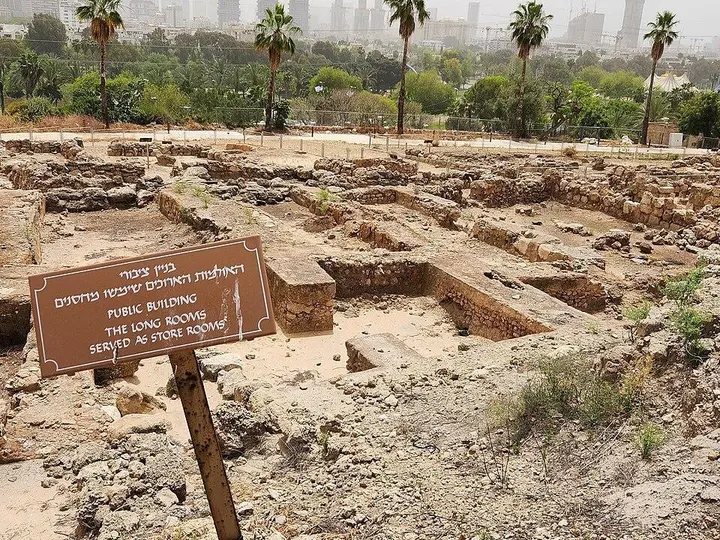
This compassionate description in Mishpatim appears in a letter by an ordinary Hebrew laborer from Metzad Chashavyahu, near Yavneh-Yam, south of today's Kibbutz Palmachim. What is moving is that a modern Hebrew speaker can read and understand the inscription almost word for word, 2,700 years after it was written. It is a little challenging, but here is the complete inscription in translation. Try spending a minute deciphering it. The laborer writes to the local official:
“Let my lord the official hear the word of his servant.
“Your servant was a reaper; your servant was at Chatzar Asam.
“Your servant reaped, finished, and stored the grain as usual before Shabbat.
“When your [s]ervant had finished his reaping and stored the grain as usual,
“Hoshayahu son of Shovai came and took your servant's garment.
“When I had finished my reaping these days, he took your servant's garment.
“All my brothers will testify for me, those reaping with me in the heat of [the] su[n].
“My brothers will testify for me: truly, I am innocent of [guilt. And now, please let him return] my garment,
“and I appeal to the official to ret[urn the garment of] your ser[vant,
“and sho]w him mer[cy, and ret]urn the [garment of] your servant, and do not send me away in disma[y...]”
In simple terms:
A laborer harvesting wheat in Yavneh's fields during King Yoshiyahu's (Josiah's) reign appeals to the regional official with a complaint: Hoshayahu son of Shovai has taken his garment, either as collateral or because he believes the laborer did not work well enough. The laborer now has nothing to cover himself with in the intense heat of the sun.
He notes that all his fellow laborers agree he has been wronged, and asks the official to ensure that his garment is returned.
The letter is instructive, illuminating several fascinating points:
1. The legal rule appearing in Mishpatim was known among the people, which is why the laborer felt he had a strong claim.
2. A garment in antiquity was substantial, valuable, and important, worth writing a formal letter to recover.
3. Metzad Chashavyahu, on the coastal plain, was controlled by Judeans, evidence of territorial expansion in King Yoshiyahu's reign reaching the coastal plain itself.
4. The letter suggests that literacy was widespread even among ordinary working people in Yisrael (Israel), something very uncommon among other ancient peoples.
5. Perhaps most important and moving: in Yisrael there is law and there is a judge. Even an ordinary laborer in a peripheral town knows he has a voice. His employer cannot mistreat him at will. He has someone to turn to, can present an orderly case, and can obtain justice. Mishpat, justice, rather than mispach, bloodshed.
The laborer of Metzad Chashavyahu shows that even an ordinary person from the lower strata, forced to work for others under a scorching sun, knows the Torah's laws and knows how to write. Above all, he knows that this is not Egypt: every laborer has the right to complain about wrongs committed by those more powerful and to obtain justice.
Mishpatim lays the foundations of justice for the people of Yisrael. Some commentators regard it as the basis of all the Torah's commandments governing relations between people; everything following is detail. It understands that the road to the “kingdom of priests and holy nation,” the calling of an exemplary society given at Mount Sinai, runs not only through lofty spiritual words but through detailed laws that enact justice, especially for those who most need it: slaves, ordinary laborers, borrowers, and the poor. To reach an exemplary society of justice and morality, we must begin with them.