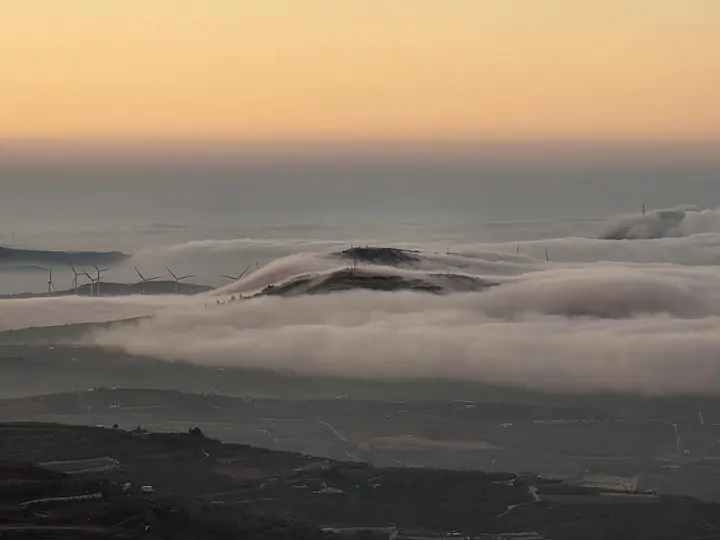

Just a few days ago, we had a fierce heatwave with temperatures above thirty degrees Celsius; this week a cold spell is arriving. In truth, this is typical of “crazy Adar,” beginning today. This wild weather, together with the dazzling blossoms, offers a fascinating perspective on Adar's natural connection to the Land of Israel.
We usually emphasize the historical side of Purim and Adar. Like all Jewish festivals, however, Purim is also strongly connected to the land's nature.
To begin with, dressing in costumes of every shape and color at Purim directly mirrors the Land of Israel's nature:
Adar is when spring reaches its height, the most colorful and fragrant month for our flowers. One thing I love about Israel's flowering season is its waves of color. It begins with the almond trees' white wave, moves into the anemones' red wave, then the catchflies' purple, then the yellow of thorny broom and crown daisies. In mid-Adar, all the waves converge into an unmatched celebration, with hundreds of fragrant flowers blooming in every color of the rainbow. The variety of senses awakened by Purim simply mirrors the land's nature, which also wears a fragrant costume full of shapes and colors in Adar.
This connects to Purim's deepest nature: it is celebrated with all the human senses in their full strength, taste, smell, sound, and sight.
Purim has another side too: the famous venahafoch hu, "it was turned about." This is the scroll's secret: bitterness becomes sweetness, and crisis suddenly reveals itself as a herald of good.
This secret of Purim's reversal also has an echo in life in the Land of Israel:
Adar, between winter and the warmer spring, is characterized by extreme swings between cold and heat. In Mediterranean countries, March, roughly corresponding to Adar, is commonly called “crazy March,” marzo pazzo, because its wild weather includes very hot days alongside freezing ones.
These frequent reversals of “crazy Adar” already appear in the Sages' writings, in an amusing Talmudic saying attributed to cattle herders:
“If an ox nearly dies in the morning snow, and at noon lies in the fig tree's shade and would shed its hide, this is Adar; if not, this is not Adar” (Sanhedrin 18b).
In a freer rendering:
“If the morning is so cold that the ox almost dies of it, and noon so hot that it wants to take off its skin beneath the fig tree, that is a sign that the month is Adar.”
A beautiful example of Adar's extremes comes from an important event in this month at the War of Independence's end. As we know, the war ended with Operation Uvda, which captured the Negev Highlands and southern Negev all the way to Eilat. In its diaries, from Adar, commanders complain of both freezing cold and unbearable heat. On the morning of 5 Adar, March 6, Uzi Narkiss, the Negev Brigade's operations officer, writes:
“At night in Ras Raman, the cold was terrible. Everything froze: the water in the radiators, the engine oil. In the morning, we had to warm the vehicles with Primus stoves.”
They experienced freezing cold. Yet only four days later, on 9 Adar, the day Eilat was captured, Avraham Adan, known as Bren, writes:
“A scorching sun and a heavy heatwave joined forces against us, and we continued advancing from bend to bend...”
The differences between Adar's freezing cold and extreme heat thus emerge in the operation's diaries. This operation ended just days before Purim, and at its conclusion Eilat's liberators sent Ben-Gurion the message:
“Convey to the Government of Israel: For Haganah Day, 11 Adar, the Palmach's Negev Brigade and the Golani Brigade present the Gulf of Eilat to the State of Israel.
“Eilat (Umm Rashrash), 9 Adar 5709.”
Adar therefore brings a wild roller coaster of heat and cold, rises and falls. This is the land's natural venahafoch hu, telling us that sometimes these very ups and downs are the road we must travel to reach spring, the festival of freedom.