
Only while fighting in Khan Yunis, when for the first time in my life I spent more than two months without electricity, did I truly understand the full moon's emotional significance.
We were there for almost two uninterrupted months with no electricity at all, forbidden to turn on any light at night. You simply come to understand many things about ancient life.
At the end of the Hebrew month, the nights were so dark that you could not see a meter ahead, indoors or out, and a kind of sadness settled over the soul.
But when the moon was full: a celebration.
You could really feel it in the team. Suddenly, a guard shift at three in the morning with a friend became an encounter full of splendor. We actually raised cans of strawberry drink in a toast. I swear.
This explained so much about why most of our joyful, uplifting festivals fall exactly in the middle of the month, when the moon is full:
Sukkot, the festival of “rejoice in your festival,” on 15 Tishrei;
Purim, when joy increases, on 14–15 Adar;
Pesach (Passover), the birthday of the people of Yisrael (Israel), on 15 Nisan;
and Tu B'Av, the festival of unity and love, on 15 Av.
Before the war, I understood the connection to the full moon, but regarded it as practical: a full moon makes it easier to hold a festive evening meal outdoors in splendid light.
Only in the war, after almost two and a half months without electricity, did I understand it deeply.
On full-moon nights, the soul really is joyful. At the Hebrew month's end, when the nights are darkest, it feels low.
This is why the moon's appearance was once celebrated with great joy. Every Rosh Chodesh, the beginning of the month, was once a true festival: from that point, light returns increasingly, and we are on the month's joyful side.
Aviv Geffen, then, did not quite get it right when he wrote:
“When God created the darkness,
He created a moon for us
so they could see how lonely we are.”
The opposite, Aviv. The moon brings us together.
And more broadly,
the moon affects us and our world far more than we usually think. The tides of the seas; the human menstrual cycle of about twenty-nine to thirty days, apparently due to ancient synchronization with the moon; and even the seasons, connected to the earth's tilted axis, which was apparently stabilized by its gravitational relationship with the moon.
And of course, Tu B'Av, the festival of the beautiful full moon.
In antiquity, the daughters of Yisrael wore white clothing on this festival, which began at night with the traditional grape harvest.
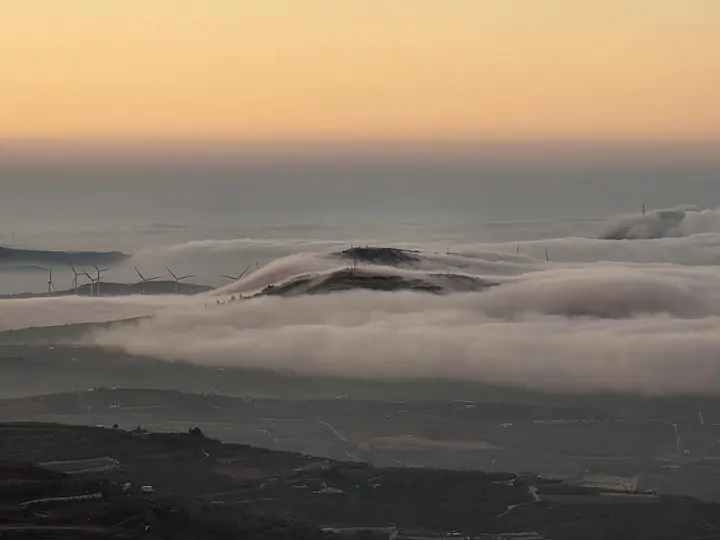
This festival opens the Hebrew calendar's white days. It begins with a white moon and women dressed in white. The whole land, too, puts on a white dress: summer begins to cool, white morning clouds wrap the valleys, and white squills rise everywhere at precisely mid-Av. Their Hebrew name, chatzav, echoes chatzi Av, "half of Av." Together, these smooth and whiten what remains of the harsh, thorny summer, calling us to see the good and the elevated,
both within ourselves and in others.