It is fascinating that the only stone of the priestly breastplate found in the Land of Israel belongs to the only tribe whose ancestor was born there. A few years ago, I was thrilled to find this gemstone in one of the Negev's most isolated regions. Here is an opportunity to tell its story. A few words, then, about the secret of yashfeh, my favorite of all the breastplate's stones, and to my mind the most distinctive.
1. In the Torah portion of Tetzaveh, in the Book of Shemot (Exodus), the twelve breastplate stones first appear. The breastplate was an extraordinary garment worn by the High Priest, set with twelve precious gemstones. Each had a different color corresponding to a tribe of Yisrael (Israel), since each tribe has its own character and distinctive shade in the Israelite mosaic: "The stones shall correspond to the names of the sons of Yisrael, twelve, according to their names; each shall be engraved like a seal with its name, for the twelve tribes."
2. While each breastplate stone had one distinctive color, green or orange, purple or red, one stone contained several colors: Binyamin's (Benjamin's) stone, yashfeh. A centuries-old midrash states: “Binyamin: his stone is yashfeh, and the color of his stone resembles all the colors, the twelve colors” (Bamidbar Rabbah 2:7). We will see the significance of this variety shortly, but first let us find the stone.
3. Like every breastplate stone, yashfeh has several proposed identifications. It is commonly identified with jasper, gemstones characterized by different colors within a single stone. The trouble is that “jasper” itself has several meanings: colored quartz, or flint containing iron oxides. But let us not complicate things first thing in the morning...
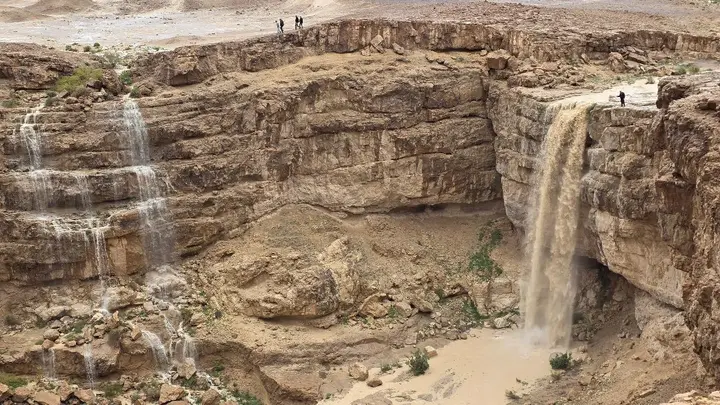
4. A few years ago, I had the good fortune to explore the Menucha ridge with Gideon Rogolsky of Moshav Paran. This isolated ridge in the southern Negev lies south of Nahal Paran. Its distinctive feature is that it is the only place in Israel where iron mines existed. Yes, the entire ridge is characterized by veins of iron rising from the earth and giving it its reddish color. Some rocks contain more than seventy percent iron. The mine itself was not commercially successful and was abandoned a few years after opening.
5. Although extracting the iron proved unsuccessful, the mountain's high proportion of iron oxides affects all its rocks. At its foot lie unusual flint stones, different from those elsewhere in the country. Having undergone ferruginization—enrichment with iron—they have become very colorful. Break through the outer patina and a smooth, colorful interior is revealed, in shades of yellow, red, purple, brown, and white. As I picked up these stones and marveled at their beauty, Gideon told me: "I think this is the biblical yashfeh from the High Priest's breastplate."
6. The beautiful, colorful stone of the Menucha ridge does broadly fit the descriptions of multicolored yashfeh, though I must emphasize that this is by no means the only view. Still, if yashfeh is a stone of this kind, there is something lovely here:
Binyamin is the only tribe whose ancestor was born in the Land of Israel; his brothers were all born in Charan (Haran). He is indeed a tribe deeply of this land, whose territory touches no external border, unlike most tribes. How fitting that, while most breastplate stones must be brought from distant places, Binyamin's can be found within the Land of Israel itself, in the Paran wilderness.
7. But how does the multicolored yashfeh specifically suit Binyamin's character?
We have already noted that each stone's color symbolizes its tribe's qualities. The multicolored yashfeh therefore brings together the shades of all Yisrael's tribes: “The colors of those stones correspond to the colors of their qualities above. Reuven, who alludes to the attribute of judgment, has odem as his stone; Binyamin, who comprises all the attributes, has yashfeh, which comprises many colors” (Rabbeinu Bachya on Genesis 49).
Binyamin's central quality was indeed his ability to unite the tribes of Yisrael. This appears throughout history, beginning with his birth: he is the last of the tribes to be born, completing their number. Only after his birth does the text say, “Yaakov's sons were twelve.”
It continues in the bitter quarrel among the tribes in the story of “Yosef and his brothers.” Thanks to young Binyamin, Yosef (Joseph) reveals himself, and the brothers make peace and reconcile. Centuries later, when the tribes are divided again in the judges' period, King Shaul comes from Binyamin and unites them. Accordingly, most of Yerushalayim (Jerusalem), the city of peace, was assigned to Binyamin's territory. Yerushalayim, which “was not divided among the tribes,” emphasizes the connection among all their colors.