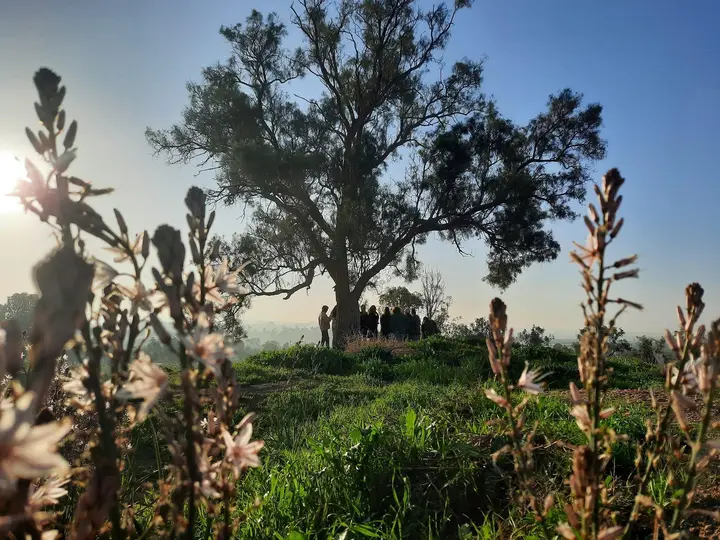

In antiquity, sleeping alone outside a town was almost a death sentence. The few who did so had to build a shelter of stones around themselves against the cold and wild animals. This, quite simply, is what Yaakov (Jacob) builds around himself on that fateful night at Beit El (Bethel): protection, a little home. One of those stones supports his head.
Before returning to the stone enclosure, we should understand something about Yaakov's journey from Be'er Sheva (Beersheba) to Charan (Haran).
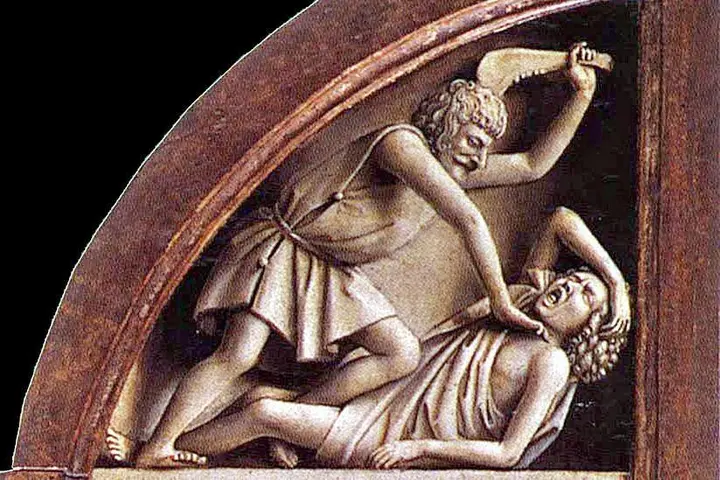
A solitary journey was extremely unusual in antiquity. Until now, the patriarchs always traveled with an accompanying household. In the Hebrew Bible, people almost always walk in groups, or with at least one companion. Walking alone is unheard of. Furthermore, sleeping outside towns is almost unheard of too: every effort is made to enter a protected place. Sleeping outside means robbers, lions, and leopards. That is why the only person in Bereishit (Genesis) punished by having to wander alone, Kayin (Cain), is terrified: “Anyone who finds me may kill me.”
And Yaakov walks alone. Terrifying.
Yet it is precisely because this journey is so unusual that it matters so much. This journey, described in just a few words, brings about the greatest change in Yaakov's inner life:
Looking at Yaakov's stories, one almost sees two different people. In the portion of Toldot, he is passive, submissive, directed by his mother Rivka (Rebecca). In Vayetze, he already rolls an enormous stone from the well's mouth, tends vast flocks, and confronts Lavan (Laban).
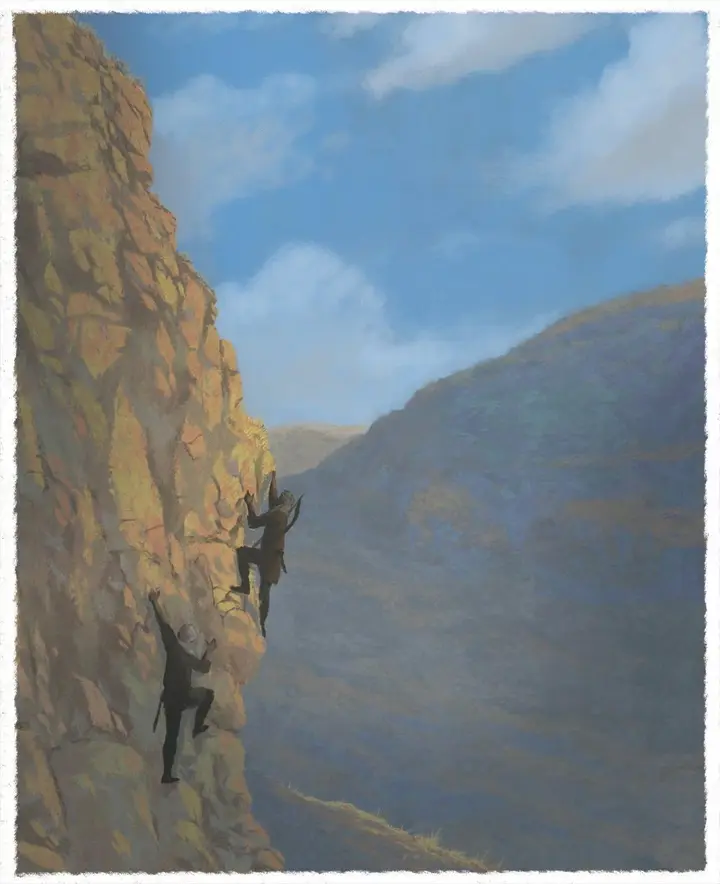
Between these two Yaakovs lies an unusual, frightening journey: one man walking alone from Be'er Sheva at the northern edge of the Sahara to Charan in southern Turkey.
At sixteen, I set out on the journey that changed my relationship with the land. Before it, I had either been taken on hikes by others or made independent trips of a day or two. Then I decided to walk from the Golan to my home in Peduel. Seven days. I knew nothing about long journeys and learned everything through mistakes: too much equipment and a dreadful backpack, which made me abandon half my gear after two days; serious navigation errors, which later taught me to read a map; long night walks because I wanted to reach my targets; and the simple realization that anyone who sleeps on an ant nest wakes with a head full of ants. At the journey's end, from Kfar HaRoeh to Peduel, I walked alone, including a full night without stopping. I was afraid to sleep alone, so I simply walked all night. It was a formative journey. Journeys change the human soul.
Back to Yaakov. In his time, the great, dense forest of Ephraim began north of Beit El (Joshua 17). Archaeological evidence shows almost no settlements between Beit El and Shechem in this period. The Hebrew Bible describes deadly bears in this region, in Elisha's story, and deadly lions, in the story of Yeravam (Jeroboam). The last leopard seen in the Shomron (Samaria) was spotted in this region fourteen years ago. Even today, Wadi Nimr, “Leopard Valley,” preserves the memory of the wild animals that lived here until relatively recently.
Yaakov, alone and fleeing his home, finds himself at night on the edge of a forest full of leopards, bears, and lions. He does what little he can to protect himself: surrounds himself with an enclosure of stones, as people on long journeys still do today.
Cast out and abandoned like this, Yaakov finds that this little stone enclosure becomes a home. In his dream, he is now protected, with angels guarding him from all harm. The little enclosure becomes a great comfort: a home in which God alone protects him, Beit El, “House of God.”
This was Yaakov's coming-of-age journey. By its end, he would be a different person.
A person able even to roll a huge stone from a well's mouth.
Years would pass.
Yaakov would return to the land, old and scarred.
He loves Yosef (Joseph) dearly. But privately, he admits that Yosef is a little spoiled: fussing over his hair, bringing bad reports about his brothers.
So when Yosef's brothers go to Shechem, Yaakov decides that Yosef, like him, must undergo a coming-of-age journey, alone.
Parents tend to think their children should undergo life journeys like their own.
Yaakov sends Yosef on an exceptionally unusual journey, from Chevron (Hebron) to Shechem, through the dark forests of the Ephraim hills.
For the rest of his life, he will regret having sent him alone. All his life. How could I? How?! How...
When Yosef's bloodstained tunic reaches Yaakov, he does not hesitate before crying: “A wild beast has devoured him! Yosef has surely been torn apart...”
Yaakov had been there himself, on that lonely night at Beit El, hearing the roars of lions and wolves rising from the forest all night...
Yaakov set out. Yosef set out.
A long journey can bring maturity.
A long journey can leave scars.