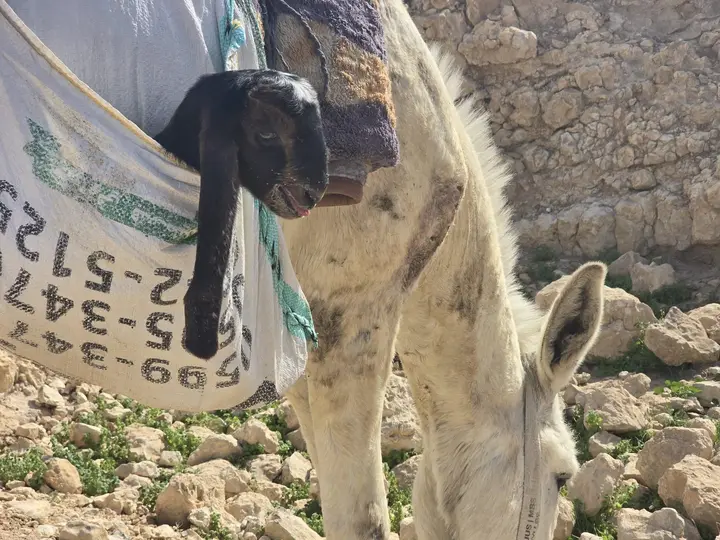
The she-camel has a fascinating trait that distinguishes her from other domesticated animals: throughout the period in which her calf nurses, mother and calf cannot be separated.
Separate a cow or sheep from her young, for example, and she will be distressed briefly but continue producing milk for a long time. Take a she-camel's calf away, however, and she will become frantic. Even if you manage to separate them, she will stop producing milk. Her calf must remain beside her. When I spoke with a camel-raising expert, he confirmed this and added that Bedouins milk the mother while the calf nurses from an adjacent teat. This phenomenon is already hinted at in Bereishit (Genesis). When Yaakov (Jacob) sends animals as a gift to his brother Esav (Esau), it says: “Two hundred she-goats and twenty he-goats, two hundred ewes and twenty rams. Thirty milch camels with their colts...”
Notice that only the she-camels are explicitly listed together with their young. They cannot be separated from them. Some suggest that this is the origin of the Hebrew name gamal, camel: because it is difficult to wean it, lehigamel, to stop it nursing. Ending nursing is called gemilah in the Hebrew Bible: “She nursed her son until she weaned him” (1 Samuel 1:23).
Another association appears in Hasidic interpretation: gamal, the camel, alludes to gemilut chasadim, acts of lovingkindness.
Is there a connection between the camel's weaning and acts of lovingkindness?
One of the central stars of the Torah portion of Chayei Sarah is the camel. The portion deals almost entirely with finding a wife for Yitzchak (Isaac), son of Avraham (Abraham), and camels appear again and again: Eliezer and the camel caravan, Rivka (Rebecca) watering the camels, and her encounter with Yitzchak, when she falls from the camel. Camels run through the entire portion.
Its climax is the remarkable test devised by Avraham's servant to find the woman worthy of Yitzchak. The servant has ten camels. If a young woman sees him after his difficult journey and says, “Drink, and I will also water your camels,” she is worthy of entering Avraham's household. A thirsty camel can drink about a hundred liters in ten minutes. Multiplied by the servant's ten camels, that is a thousand liters the young woman must draw by hand from the deep well...
Rivka passes the test, watering Eliezer and all his camels, pitcher after pitcher after pitcher...
This is no arbitrary test. At its simplest, of all Rivka's good qualities, it tests her lovingkindness. Avraham's household is known for welcoming guests, which is not always easy and demands devotion. Rivka's devotion shows that she is worthy of joining it.
Hospitality is a central value in all desert cultures, and not by chance. Desert scarcity and the simplicity of its inhabitants require the heart to open to others. A thirsty person understands another's thirst and opens his home. The camel is one of the principal symbols of desert cultures. For Bedouins, the camel's “lovingkindness” comes from its entire being: they ride it, milk the females, eat its meat, and use its hide and wool. No other domestic animal serves all these purposes. The camel is therefore the desert dwellers' defining symbol; they cannot do without it. As we know, the more synonyms a culture has for something, the greater its importance. Bedouins have thirteen different names for camels: al-ibil, an-naqah, al-'ir, al-budn, al-jamal, al-him, al-ba'ir, al-an'am, al-bahirah, as-sa'ibah, al-wasilah, al-ham, and al-'ishar. My thanks to Tzafrir Tiferet, a man of the Negev Highlands, who taught me this.
The she-camel nursing her calf with endless devotion, the camel whose entire body is put to use, thus symbolizes total lovingkindness, the quality of desert people.
At the portion's end, however, Rivka falls from the camel.
Something in this total devotion falls away.
In truth, this fall almost has to happen. The danger for great people of kindness lies in their kindness itself. Total devotion to others can come at the expense of one's own home. Avraham seems to have learned this painfully at the end of his life. After the binding, Sarah dies of grief. Yitzchak, who only yesterday offered his neck to slaughter, now has an invisible knife pierce his heart and withdraws from Avraham's tent to distant Be'er Lachai Ro'i, probably near today's Mashabim Junction. Yishmael (Ishmael) is far away in the Paran wilderness. Avraham, the great man of kindness toward the whole world, has lost his immediate family.
Rivka's fall from the camel symbolizes a silent declaration: Our home, dear Yitzchak, will be different.
And indeed, Yitzchak and Rivka's household is so different from Avraham's.
Avraham wanders throughout the world, from Perat (the Euphrates) to Egypt. Yitzchak and Rivka's home lies in the small triangle between Be'er Sheva (Beersheba), Chevron (Hebron), and Gerar. Avraham's home is full of guests; Yitzchak's speaks entirely of drawing inward. Avraham has three wives; Yitzchak and Rivka have only one another, the first couple in the Hebrew Bible explicitly said to love. Avraham is a wandering shepherd; Yitzchak is a farmer, sowing in the land and finding blessing in it.
Gemilah, weaning, also means stopping: a complete break from something beloved and addictive, whether mother's milk or a drug. Yitzchak understands that an addiction to kindness has its costs. He weans himself from kindness directed wholly outward and turns inward, homeward, to love his wife and two children. He prefers the fire of love burning within the home to the flaming torches sent outside. Sometimes the blind Yitzchak saw better than everyone.