
What is it about the Yarden (Jordan) that brings a profound inner change to those who cross it—a true metamorphosis?
From the people of Yisrael (Israel) entering the land, through the change in David when he crosses the Yarden, to Naaman, commander of Aram's army, whose personality is truly transformed when he immerses in it.
The Yarden is the world's lowest river. It runs the length of inhabited Israel, from the snowy heights of Mount Hermon to the Dead Sea. It is one of six rivers descending from the three snowy mountain regions of the Land of Israel's wider surroundings: the Orontes and Litani, originating in the Lebanon Mountains; the Yarmuk, originating on the edges of Mount Bashan, the Hauran or Jabal al-Druze; and the Hermon range, which produces three rivers, Amana, Parpar, and the Yarden.
But do not imagine that the Yarden you see today is the original river. Its flow south of the Kinneret (Sea of Galilee) was once about 970 million cubic meters a year; today it is only about seventy million, less than a tenth! The reasons are the Degania Dam, which blocks most southward flow, and Jordan's Ghor Canal, which diverts the Yarmuk's water, 430 million cubic meters annually, to agriculture in the Jordanian valley instead of letting it reach the Yarden.
Viewed through the Hebrew Bible, however, the Yarden seems to be more than an ordinary river. It is an inner boundary: those who cross it undergo an essential change.
Many people crossed the Yarden throughout biblical times, of course. Yet those whose crossings the Hebrew Bible dwells upon seem to carry particular significance. Let us consider what they share:
Our forefather Yaakov:
The first explicitly described person to cross the Yarden was our forefather Yaakov (Jacob), fleeing his brother Esav (Esau). He describes that crossing as a difficult moment when he was alone and possessed nothing. He returns to it, however, with a large, established family:
“For with my staff alone I crossed this Yarden, and now I have become two camps” (Genesis 32:11).
Indeed, just before crossing the Yarden for the second time, and before his confrontation with Esav, Yaakov receives his new name, Yisrael. It expresses a profound change in his nature: no longer Yaakov, associated with a heel and with submission, but Yisrael, standing straight and upright, fighting for what he holds dear.
The people of Yisrael:
The next crossing of the Yarden is by the entire people of Yisrael after forty years of wandering in the wilderness. Its significance can hardly be overstated. The Book of Joshua devotes almost four entire chapters to it, describing it in great detail, culminating in:
“The waters coming down from upstream piled up in a single heap... The priests who bore the Ark of God's Covenant stood on dry land exactly in the middle of the Yarden, while all Yisrael crossed over on dry land, until the entire nation had finished crossing the Yarden” (Joshua 3:16–17).
This crossing symbolizes a clear metamorphosis undergone by the people of Yisrael:
From the wilderness generation to the generation inheriting the land. From eating manna, bread given freely, to eating the land's bread, earned through sweat. From the children of Yisrael to the people of Yisrael. From Moshe's (Moses') sunlike leadership, dazzling in its light, to Yehoshua's (Joshua's) moonlike leadership, allowing the light of individual Israelites to shine. With the crossing of the Yarden, the history of the people of Yisrael in their land begins, as a people arising on their own soil.
The people of Gad and Reuven:
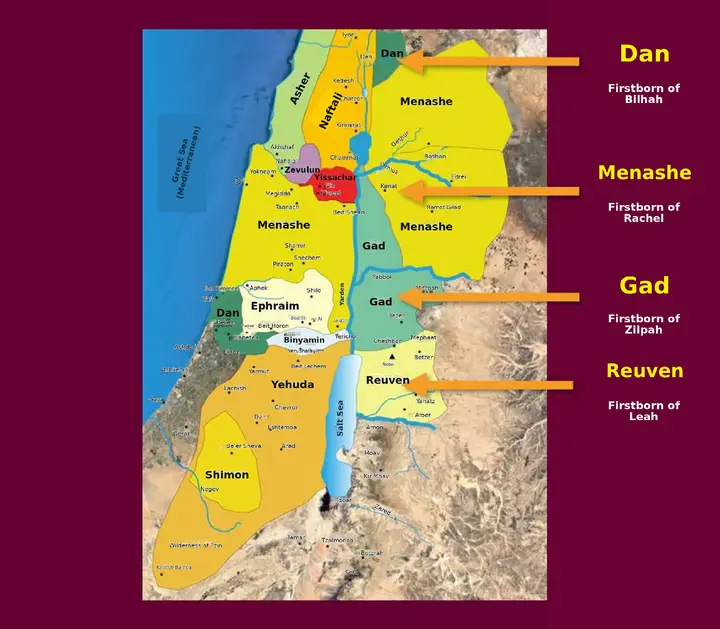
In keeping with the great significance of Yisrael's crossing, fourteen years later, when Gad and Reuven (Reuben) crossed the Yarden in the opposite direction, eastward, and built an altar beside it, Yisrael initially regarded this as a reverse metamorphosis, a separation from Yisrael:
“God has made the Yarden a boundary between us and you, people of Reuven and Gad. You have no share in God! Thus your children might prevent our children from fearing God” (Joshua 22:25).
Gidon the judge:
Gidon (Gideon), too, crosses the Yarden on his military campaign. After his great victory over Midian in the Yizreel (Jezreel) Valley, he continues the pursuit, crossing eastward:
“Gidon came to the Yarden and crossed it. The three hundred men with him were famished, but still in pursuit” (Judges 8:4).
When I taught the Book of Judges, I tried to show that Gidon's crossing is a watershed in his life, and indeed in the entire book. Once he crosses eastward, he embarks on a personal campaign of revenge that goes beyond the war of deliverance he began. From that moment, most of the army leaves him, with only three hundred men remaining. He becomes embroiled in two internal conflicts with the inhabitants of Sukkot and Penuel, and punishes them harshly. This begins the less successful phase of Gidon's leadership. It is also the moment when the Book of Judges shifts from judges with a broad national outlook to local judges with narrower personal interests.
King David:
King David's crossing of the Yarden is also deeply significant. It occurs at one of his life's lowest points, during Avshalom's (Absalom's) rebellion. Avshalom has taken the capital, Yerushalayim (Jerusalem), and plans to pursue David, his father, into the wilderness and kill him. David is fleeing for his life, with his pursuers liable to catch him at any moment. Then he crosses the Yarden:
“They said to David, ‘Go and cross the water quickly...’ David and all the troops with him promptly crossed the Yarden, and by daybreak not one was left who had not crossed the Yarden” (2 Samuel 17:21–22).
The eastward crossing symbolized one of David's lowest moments and his effective removal as king of Yisrael. Yet the very same Yarden, when David crossed westward, also symbolized his return to kingship: “The king returned and reached the Yarden, and Yehuda came to Gilgal to meet the king and bring him across the Yarden” (2 Samuel 19:16).
David's crossing occupies an entire chapter, describing all his encounters at the river. They share a single meaning: the renewed acceptance of David's kingship. At the Yarden, the kingship of the House of David was restored.
Eliyahu and Elisha:
The next to cross are two men, Eliyahu (Elijah) and Elisha:
“The two of them stopped at the Yarden. Thereupon Eliyahu took his mantle and, rolling it up, he struck the water; it divided to the right and left, so that the two of them crossed over on dry land” (2 Kings 2:7–8).
As with the people of Yisrael, the Yarden parts for Eliyahu and Elisha, and they cross on dry ground. For each, the crossing symbolizes a profound change. For Eliyahu, the Yarden is the gateway to heaven: standing at the river, he is taken upward in a chariot of fire with horses of fire, transformed from a flesh-and-blood man into something like a heavenly seraph. For Elisha too, the crossing is fundamental. He changes from Eliyahu's attendant, as yet without prophetic inspiration, into a man receiving a double portion of his teacher's spirit, becoming a man of God and a worker of wonders.
Naaman, commander of Aram's army:
The next person is an Aramean: Naaman, commander of Aram's army, afflicted with tzara'at, the biblical skin affliction. Elisha tells him that to be healed he must immerse in the Yarden. Naaman accepts the instruction and immerses seven times:
“So he went down and immersed himself in the Yarden seven times, as the man of God had bidden; and his flesh became like a little boy's, and he was clean” (2 Kings 5:14).
Naaman's transformation is sharp and striking. At the chapter's beginning he is described as a “great man”; now he becomes like a “little child.” It seems he was healed of more than tzara'at. He shed the pride that clung to him, took off the garments of his authority, and descended into the world's lowest river, where his soul found peace. As the rest of the chapter shows, he emerged from the Yarden truly a new man, with a new spirit. He became a symbol of the nations and of friends of Yisrael who recognize Yisrael's distinctive quality.
***
There is something about the Yarden, then, that brings profound change to those who cross it. Perhaps it is rooted in the river's geography. It connects life, the Kinneret, with the sea of death, the Dead Sea. How extraordinary is the Yarden, whose Hebrew name evokes “descending from Dan,” flowing from Hermon's snows and bringing life to one lake and death to another. The Kinneret, which the Yarden enters and leaves, both receiving and giving, is the lake of life and sweetness. The Dead Sea only takes, never releasing or giving its waters, and so absorbs all the salts carried by the Yarden. With no outlet, these salts accumulate until they turn the southern lake into a place where almost no living creature can survive.
Between them lies the Yarden, like a balance.
Those who pass through it undergo immense transformations: between emptiness and fullness, like Yaakov; between wilderness and cultivated land, like Yisrael; between the personal and the national, like Gidon; between persecution and kingship, like David; between fire and water, like Elisha and Eliyahu; between tzara'at and purity, like Naaman. The Yarden, the world's lowest river, takes those who cross it to heights far above it.