Yesterday I took my children to the place where Gehinnom, hell, and the Garden of Eden meet. Surprisingly, these two places come together at a very special location, here on earth, at the foot of ancient Yerushalayim (Jerusalem).
In the days leading up to Tisha B'Av, the fast commemorating the Temple's destruction, I took my children on a walk through ancient Yerushalayim. We descended through Gei Ben-Hinnom, the Valley of the Son of Hinnom, and reached its meeting point with the Kidron Valley. Near that confluence lies the Shiloach (Siloam) Pool, which collects the waters of the Gichon Spring, Yerushalayim's great spring.
The meeting of the Gichon's waters with Gei Hinnom at the foot of Yerushalayim is also a linguistic and geographical meeting between Eden and Gehinnom. Gichon is the name of one of Eden's rivers, while Gei Hinnom echoes the name Gehinnom, hell.
I told the children that this meeting of valleys may be one of the most significant in the world. Let me try to explain why.
Let's begin with the Gehinnom beside Yerushalayim:
We tend to think of Gehinnom as the terrible place to which the wicked go at the end of days. Before all that, however, Gehinnom is a physical place beside Yerushalayim: Gei Ben-Hinnom, descending eastward from the Sultan's Pool toward the Kidron Valley. In the First Temple period, this place truly was a moral hell, and in fact one of the principal reasons for the First Temple's destruction. Why? Because Gei Ben-Hinnom hosted the most depraved form of worship imaginable:
The worship of Molech: sacrificing children in fire to an idol.
The Hebrew Bible recounts that altars for the worship of Molech were built in Gei Ben-Hinnom at the foot of the City of David, and two wicked kings of Yisrael, Achaz (Ahaz) and Menashe, passed their sons through the fire there. Of Achaz, for example, it says:
“He made offerings in the Valley of Ben-Hinnom and burned his sons in fire, following the abhorrent practices of the nations that God had dispossessed before the people of Yisrael” (2 Chronicles 28:3).
There is disagreement over whether Achaz and Menashe actually killed their sons or “merely” passed them through the fire as a ritual. But the words of the prophet Yirmiyahu (Jeremiah), who cries out against the atrocities committed in Gei Ben-Hinnom, suggest that actual human sacrifice took place: “They have built the shrines of Topheth in the Valley of Ben-Hinnom to burn their sons and daughters in fire, which I never commanded, which never came to My mind” (Jeremiah 7:31).
The Sages describe the cruelty of human sacrifice to Molech in harrowing language. They describe a metal bull with hands made burning hot by fire, on which the unfortunate child was placed. Loud drums were beaten to drown out the screams of the burning child.
These sins sealed the Temple's fate, as several passages state: “I will make them a horror to all the kingdoms of the earth, because of Menashe son of Chizkiyahu, king of Yehuda, for what he did in Yerushalayim” (Jeremiah 15:4).
The Sages identify a connection between Gei Ben-Hinnom and Gehinnom, transmitting this identification in the name of Rabban Yochanan ben Zakkai, who lived in Yerushalayim:
“There are two palm trees in Gei Ben-Hinnom, and smoke rises between them... This is the entrance to Gehinnom!” (Babylonian Talmud, Eruvin 19b).
The entrance to a moral hell lies at the foot of Yerushalayim.
Now to the Garden of Eden beside Yerushalayim:
The largest spring in the hills of Yehuda (Judah), and the spring that enabled Yerushalayim to become what it is, is the Gichon. Its name takes us into the world of Eden, since Gichon is the name of one of the four rivers flowing down from the Garden of Eden:
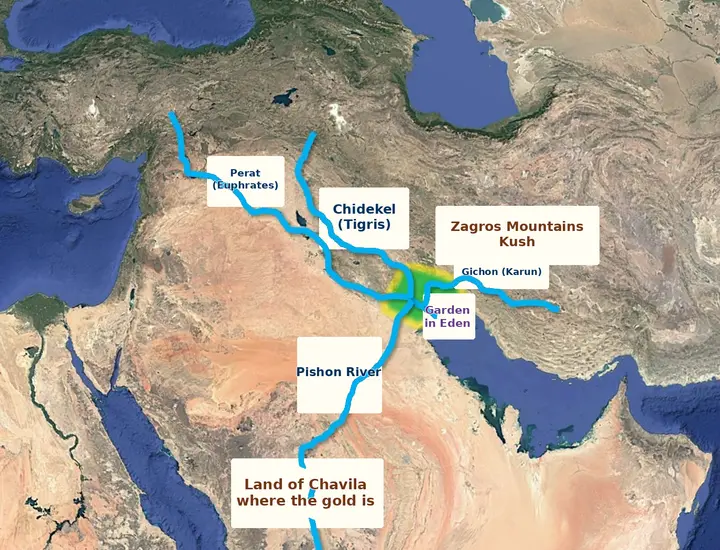
“A river issues from Eden to water the garden, and it then divides and becomes four branches. The name of the first is Pishon... The name of the second river is Gichon... The name of the third river is Chidekel... And the fourth river is Perat” (Genesis 2:10–14).
Interestingly, two of Eden's four rivers share their names with watercourses descending eastward from Yerushalayim: Nahal Perat and the Gichon Spring. I wish I could demonstrate that Nahal Refaim and Nahal Sorek, which descend westward from Yerushalayim, were once given the names Chidekel and Pishon. That would place Yerushalayim between namesakes of all four rivers of Eden. But proving that remains a task for another day.
In any case, the history of the Gichon Spring is the history of Yerushalayim. In ancient times, the spring flowed through the valley and watered fruit orchards and groves. Every ruler of Yerushalayim understood that its water had to be protected during a siege. The Canaanites built an enormous guard tower around it. Later, shafts were cut to allow water to be drawn from within the city. Chizkiyahu (Hezekiah), king of Yehuda, built a long tunnel that carried the spring's water into the city, near today's Shiloach Pool.
This spring truly acquired a special aura of holiness. It made the valley east of Yerushalayim a fertile, green place of orchards. Here the kings of the House of David were anointed. Of this place, Zecharya (Zechariah) and Yechezkel (Ezekiel) prophesied that living waters would flow out of Yerushalayim and turn the Dead Sea into a flourishing Eden. From here the High Priest drew water for the only water offering made in the Temple, on Sukkot. And from this spring, thousands of pilgrims began their ascent and purification on the final leg of their journey, from the Shiloach Pool up to the Temple Mount. The Gichon Spring: truly the waters of Eden.
In this tangible geographical way, Eden and Gehinnom met at the very southern tip of Yerushalayim:
On one side, the Gichon Spring, bringing life to the whole city and surrounded by an aura of purity and holiness.
On the other, the exposed, rocky Valley of Ben-Hinnom, from which rose the dreadful cries of human sacrifices.
What does it mean that Eden and Gehinnom meet at the very foot of Yerushalayim?
There are surely many ways to understand this. Let me suggest one:
Yerushalayim is the most important holy city of Yisrael and the world. From it came moral teaching, Torah, and prophecy for Yisrael and the nations. Yet at the foot of this holy city we are shown that Eden and Gehinnom can meet, and can be far closer than we imagine.
In a place as powerful as Yerushalayim, the danger of falling is necessarily greater. It is like a rock climber: the higher he climbs, the more devastating his fall may be. If he climbs only two meters, he can fall only two meters, and little serious harm will come to him. But when he climbs dozens of meters, the danger increases many times over.
And Yerushalayim climbed as high as one can climb, all the way to the heavenly Yerushalayim. The danger of a fall arising from its very holiness can therefore be terrible.
Thus it was King Menashe, a descendant of the House of David and son of the righteous King Chizkiyahu, who sank to the depths of worshiping Molech and offering human sacrifices. His actions brought the final, absolute decree of destruction. Perhaps Menashe himself did not think he was doing something appalling. He may even have regarded it as extreme “religious devotion” leading to human sacrifice. The prophets therefore had to cry out that such a thing had never entered God's mind.
Terrible, shocking deeds were also committed in the Second Temple period, again in the name of extreme spirituality that had spiraled out of control. The Netziv of Volozhin describes how the thousands of murders committed during the civil wars of that period were carried out with the very “intention of fulfilling a commandment.” Of these killers in God's name, he writes:
“This bloodshed [by the zealots of the Second Temple period] was not committed with the intention of transgressing, but only with the intention of fulfilling a commandment. They regarded one another as Sadducees, heretics, and informers, whom the law allowed them to put to death. What led them to think this? Nothing but baseless hatred. Thus, when someone saw his fellow commit a transgression, he did not judge that he had acted merely out of desire or the like, but that he was a heretic whom it was permissible, and a commandment, to kill” (Meromei Sadeh, Yoma 9b).
Eden and Gehinnom do indeed meet in Yerushalayim.
In a place that holds a spark of Eden, with the extraordinary purity, holiness, and connection found in Yerushalayim,
there is a lurking danger: that very holiness and purity, with all their power, can become hell on earth.
For most of the year, we remind ourselves of Yerushalayim's holy power. But on one day each year, Tisha B'Av, a harsh summer day of judgment and fire, we remember its Gehinnom side too. We recall how a mantle of holiness and purity can become the consuming fire of destruction.